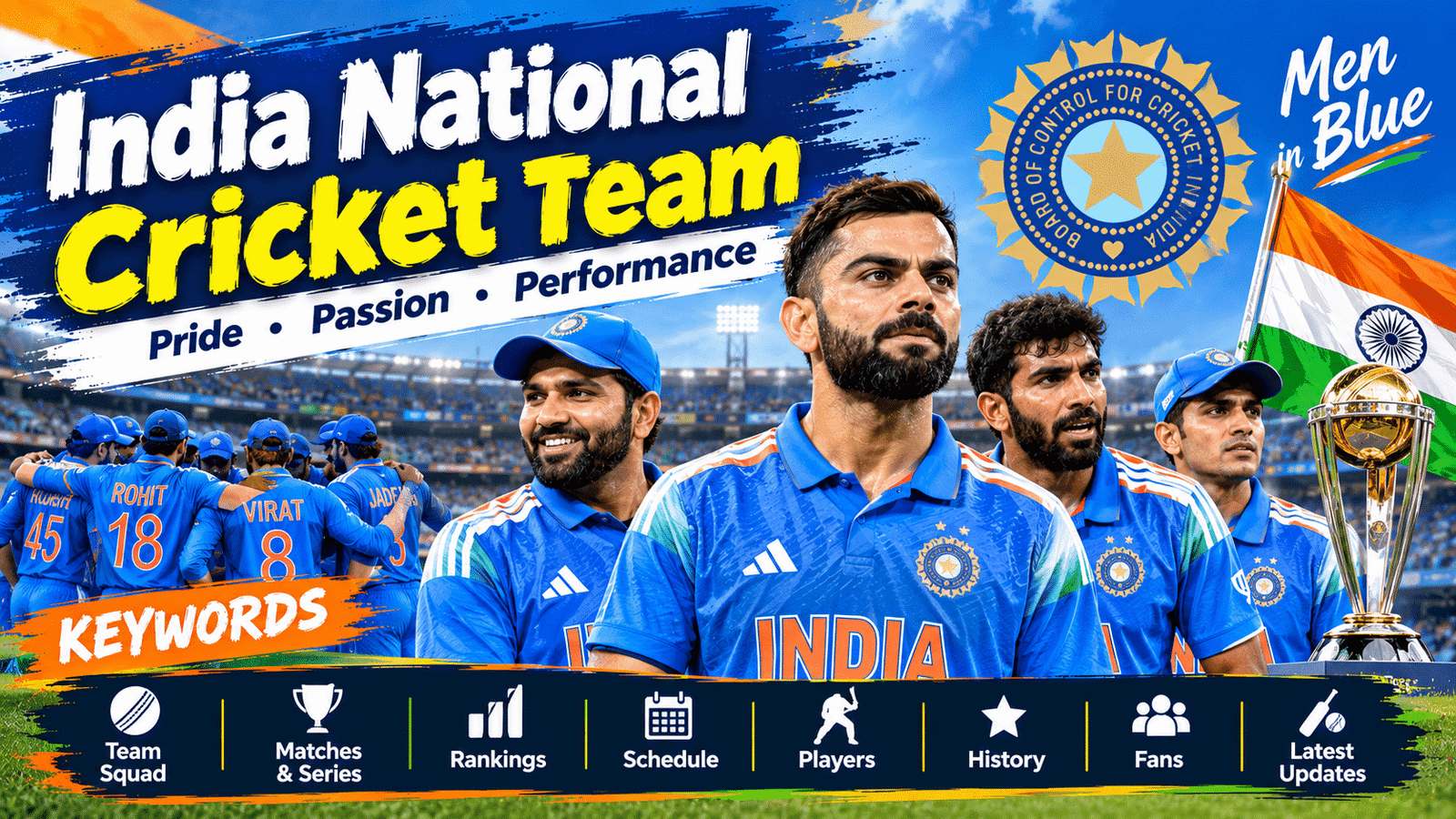
India National Cricket Team
The India National Cricket Team is one of the most recognized and followed cricket teams in the world. Representing India in international cricket, the team is governed by the Board of Control for Cricket in India (BCCI). India plays Test matches, One Day Internationals (ODIs), and Twenty20 Internationals (T20Is), competing against cricketing nations across the globe.
Over the decades, Indian cricket has developed from a relatively modest beginning into a major force in international cricket. The team has produced legendary players, memorable performances, and historic victories that have inspired millions of cricket fans.
History of the India National Cricket Team
India played its first Test match in 1932 against England at Lord’s in London. At that time, cricket in India was still developing, but the sport gradually became increasingly popular throughout the country.
After gaining independence in 1947, Indian cricket continued to grow. The national team became more competitive during the following decades and began producing players capable of performing at the highest international level.
A major turning point came in 1983 when India won its first Cricket World Cup under the captaincy of Kapil Dev. The victory significantly increased the popularity of cricket in India and became one of the most important moments in the country’s sporting history.
India National Cricket Team in Test Cricket
Test cricket has played an important role in India’s cricketing identity. The format demands patience, concentration, technical skill, and physical endurance.
India has played numerous memorable Test series against teams such as Australia, England, South Africa, Pakistan, New Zealand, Sri Lanka, and the West Indies. Home conditions have traditionally provided India with strong support, while overseas victories have also become an important measure of the team’s development.
Indian Test cricket has featured outstanding batsmen, fast bowlers, spinners, wicketkeepers, and all-rounders. Players such as Sunil Gavaskar, Rahul Dravid, Sachin Tendulkar, Anil Kumble, Kapil Dev, and many others have made significant contributions to the team’s Test history.
India’s Success in One Day Internationals
India has a rich history in One Day International cricket. The 1983 World Cup victory was followed by another World Cup triumph in 2011, when India won the tournament on home soil.
The 2011 team included several highly experienced players and talented younger cricketers. India defeated Sri Lanka in the final in Mumbai, creating one of the most memorable moments in Indian cricket.
Indian ODI cricket has also benefited from world-class batting. Sachin Tendulkar became one of the most celebrated ODI players in cricket history, while players such as Sourav Ganguly, Virat Kohli, Rohit Sharma, MS Dhoni, Yuvraj Singh, and others have contributed to India’s success in the format.
India’s Journey in T20 Cricket
Twenty20 cricket has transformed the modern game, and India has played a major role in its development. The inaugural ICC Men’s T20 World Cup in 2007 was won by India under the leadership of MS Dhoni.
The success helped increase interest in the shortest international format and contributed to the rapid growth of T20 cricket in India.
Indian T20 cricket has featured explosive batsmen, innovative bowlers, athletic fielders, and versatile all-rounders. The country’s domestic cricket structure has also provided opportunities for emerging players to gain experience in high-pressure matches.
Famous Players of the Indian Cricket Team
The India National Cricket Team has produced many legendary cricketers. Sachin Tendulkar is widely recognized for his extraordinary international batting career and became the first player to score 100 international centuries.
Kapil Dev was an outstanding all-rounder and captain who led India to its first World Cup title in 1983. Anil Kumble became one of India’s most successful bowlers and was known for his accuracy and determination.
Rahul Dravid earned a reputation as one of India’s most technically accomplished batsmen, while Sourav Ganguly played an influential role as a captain and batsman.
In the modern era, players such as Virat Kohli and Rohit Sharma have become prominent figures in Indian cricket. Kohli has established himself as one of the leading international batsmen of his generation, while Rohit has been known for his powerful batting and leadership.
Role of the BCCI
The Board of Control for Cricket in India, commonly known as the BCCI, is responsible for administering cricket in India. It organizes domestic competitions, manages the national teams, supports cricket infrastructure, and works with international cricket organizations.
The BCCI also plays an important role in developing young talent. Domestic competitions such as the Ranji Trophy provide players with opportunities to compete at a high level before potentially earning selection for the national team.
Domestic Cricket and Player Development
India’s large domestic cricket system is an important source of talent for the national team. The Ranji Trophy is one of the country’s premier first-class competitions, while the Vijay Hazare Trophy and Syed Mushtaq Ali Trophy provide important platforms for limited-overs cricket.
The Indian Premier League has also created opportunities for players to compete alongside and against some of the world’s leading cricketers. Although international selection involves different criteria, performances in domestic cricket can help emerging players gain attention.
India National Cricket Team and Its Fans
Cricket has an enormous following in India. Matches involving the national team attract viewers from different regions, languages, and age groups.
The team’s success has created a strong emotional connection between players and supporters. Major international tournaments often generate widespread interest, while victories against traditional rivals can become significant sporting events.
Indian fans also follow the team’s performances through television, online streaming, newspapers, social media, and cricket websites.
Major Achievements of India
The India National Cricket Team has achieved several significant milestones in international cricket. Some of the best-known achievements include:
- Winning the 1983 Cricket World Cup.
- Winning the inaugural 2007 ICC Men’s T20 World Cup.
- Winning the 2011 Cricket World Cup.
- Producing multiple world-class batsmen and bowlers.
- Achieving major Test victories in both home and overseas conditions.
- Developing a strong pipeline of international cricket talent.
- Becoming one of the most influential cricket teams in the modern era.
These achievements have contributed to India’s position as one of the central teams in international cricket.
The Future of Indian Cricket
The future of the India National Cricket Team depends on continued investment in player development, coaching, fitness, technology, and domestic cricket. Young players regularly emerge through India’s extensive cricketing system, providing competition for places in the national side.
Modern cricket is also becoming increasingly demanding. Players must adapt to different formats, changing tactics, advanced analytics, and demanding international schedules.
India’s large population and deep interest in cricket provide a substantial foundation for continued development. The combination of established stars and emerging talent ensures that Indian cricket remains closely watched around the world.
Conclusion
The India National Cricket Team has a remarkable history filled with legendary players, major victories, and unforgettable moments. From its first Test match in 1932 to World Cup triumphs and success across different formats, Indian cricket has undergone a remarkable transformation.
The team’s journey reflects the growth of cricket in India and the dedication of generations of players, coaches, administrators, and supporters. With a strong domestic structure and a constant supply of emerging talent, the India National Cricket Team continues to hold an important place in international cricket.